

The honest answer: Multi-City Flights vs Separate Tickets depends on the route and airlines involved, and you have to price both options every time. There is no universal rule. Multi-city tickets on same-alliance airlines can save over $1,000 on long-haul international routes. But separate tickets on budget carriers for short-haul legs can sometimes cut $200 off the same trip. This guide tells you when each option wins and exactly how to check.
Real Cost Comparison: Multi-City vs Separate Tickets
Here is a real example based on 2025 fare data so you can see how big the difference can be between multi-city flights vs separate tickets:
| Route | Multi-city ticket | Separate one-way tickets | Difference |
| Chicago to Frankfurt to London to Chicago (United + Lufthansa, Star Alliance) | $1,874 | $3,436 ($1,593 + $105 + $1,738) | Multi-city saves $1,562 |
| New York to Paris to Rome to New York (short Europe loop) | Varies — often $200 to $400 cheaper | Varies | Multi-city usually wins on long-haul |
| LA to Las Vegas to Phoenix (domestic budget) | Often no advantage | Budget carriers like Allegiant cheaper separately | Separate tickets often win short-haul |
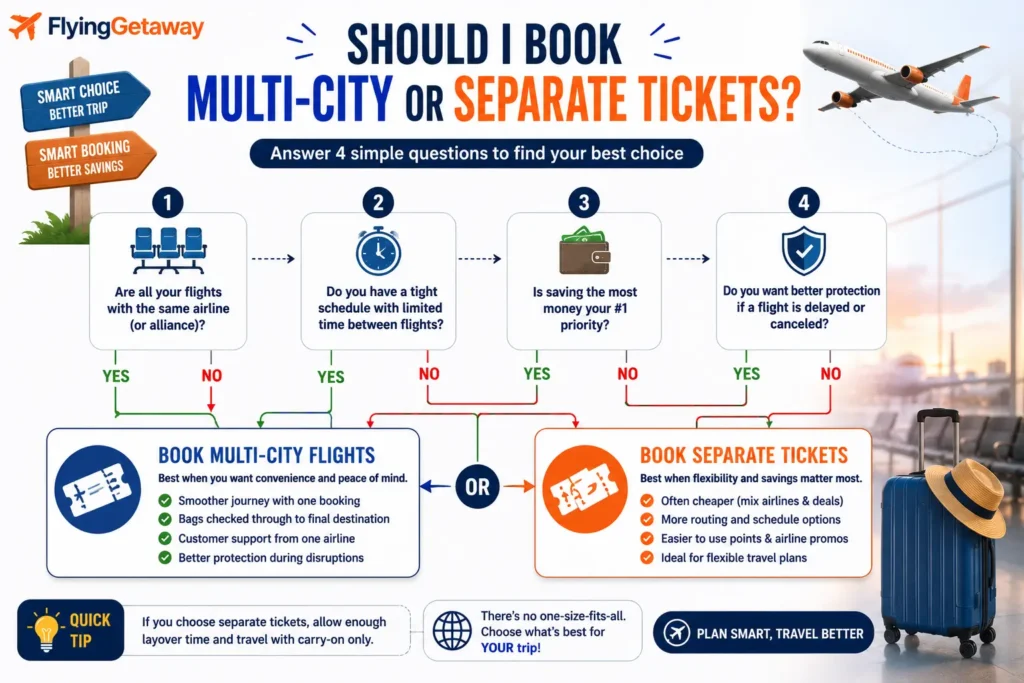
The rule: Multi-city tickets win on long-haul international routes, especially when airlines are in the same alliance (Star Alliance, Oneworld, SkyTeam). Separate tickets sometimes win on short domestic hops using budget carriers. Always price both on Google Flights before booking.
What Is a Multi-City Flight?
A multi-city ticket is one booking that covers multiple flight segments, often departing from and returning to different cities. Example: flying New York to Tokyo, then Osaka back to New York. This is called an open-jaw itinerary and is one of the most underused money-saving tools in flight booking.
All major US airlines including American, Delta, and United offer multi-city search on their websites. The key advantage when airlines are in the same alliance is that the fare is calculated as one ticket rather than two or three separate one-ways, which are always priced higher per leg.
The Biggest Risk of Booking Separate Tickets
This is what the original blog glossed over. When you book separate tickets and miss a connection, you are on your own. The second airline owes you nothing because your bookings are independent. You will need to buy a new ticket at the gate, often at full walk-up price.
When you book a multi-city ticket on one PNR and a delay causes you to miss a connection, the airline is responsible for rebooking you at no charge. This protection alone can be worth hundreds of dollars on international trips where connections are tight.
| Situation | Multi-city ticket | Separate tickets |
| Your first flight is delayed and you miss the connection | Airline rebooks you for free on next available flight | You buy a new ticket out of pocket at current price |
| Baggage handling between flights | Bags checked through to final destination on most routes | You collect bags and recheck at each stopover airport |
| Flight schedule change by airline | Airline must accommodate you on alternative routing | Each airline handles only their own segment |
| Cancellation protection | One call, one booking reference, one airline to deal with | Three separate calls to three separate airlines |
When to Book Multi-City vs Separate Tickets?
| Choose multi-city when | Choose separate tickets when |
| Flying international routes across multiple countries | Flying domestic short hops on budget carriers |
| Airlines are in the same alliance (Star Alliance, Oneworld, SkyTeam) | You find a budget carrier fare that is more than $150 cheaper per leg |
| Connections are tight (under 3 hours between flights) | You have very flexible dates and can afford rebooking risk |
| You have checked baggage | All flights are carry-on only and connections are loose (4+ hours) |
| You want one booking reference for travel insurance purposes | Each leg is a standalone trip with days in between |
How to Price Both Options in Under 5 Minutes?
- Go to Google Flights and search multi-city with your full itinerary. Note the total price.
- Then search each leg separately as one-way tickets on Google Flights. Add them up manually.
- Compare the two totals. Factor in checked bag fees if you are flying budget carriers on the separate ticket option.
- If the difference is under $100, book multi-city for the connection protection alone.
- If separate tickets are $200 or more cheaper per person and connections are loose, separate tickets may be worth the risk.
Alliance tip: If your multi-city route uses airlines in the same alliance, always check the itinerary on one of the alliance carrier websites first. United.com for Star Alliance, aa.com for Oneworld, delta.com for SkyTeam. Alliance itineraries are often priced lower than piecing the same flights together on separate tickets.
Baggage on Multi-City Flights: What Actually Happens
On a true multi-city ticket where all airlines are on one PNR, your checked bags are typically tagged through to your final destination. You do not need to collect and recheck them at intermediate stops. This is one of the most practical advantages of multi-city booking that separate tickets do not offer.
Exception: if your multi-city itinerary mixes airlines from different alliances, or if you are entering a country that requires customs clearance at the stopover, you will need to collect and recheck bags. Confirm with your airline at check-in.
Want us to price both options for your trip? Call Flying Getaway at +1 (646) 814-6001. We compare multi-city flights vs separate tickets combinations across all major US and international airlines and book whichever is genuinely cheaper for your specific route.
Frequently Asked Questions
Are multi-city flights cheaper than separate tickets?
Sometimes yes, sometimes no. On long-haul international routes using same-alliance airlines, multi-city tickets can save over $1,000 compared to separate one-ways. On short domestic hops using budget carriers, separate tickets can be cheaper. You have to price both multi-city flights vs separate tickets options every time.
What happens if I miss a connection on separate tickets?
You are responsible for buying a new ticket at your own expense. The second airline owes you nothing because the bookings are independent. This is the single biggest risk of separate tickets on tight international connections. With a multi-city ticket on one PNR, the airline must rebook you for free if a delay causes a missed connection.
Do bags transfer automatically on multi-city flights?
On multi-city tickets where all airlines share one PNR, bags are typically checked through to your final destination. On separate tickets, you generally collect bags and recheck at each stopover. Exceptions apply when you clear customs at a connecting city or when airlines are from different alliances.
Is a multi-city ticket worth it for a Europe trip?
Usually yes for US to Europe multi-country trips. Flying into London and out of Rome, for example, is often cheaper as an open-jaw multi-city ticket than booking a round trip to London and a separate one-way Rome to London. It also saves you the time and cost of traveling back to your entry city at the end of the trip.

Patrick Walker is the travel brain behind Flying Getaway. With a knack for spotting flight deals and a passion for exploring new skies, he helps travelers fly smarter and save more with every trip.