
On a codeshare flight, the airline selling the flight and the airline operating it can be different. Check the operating airline’s cabin-bag limits, then use the checked-baggage rules disclosed for your ticketed itinerary. The operating carrier or longest flight is not a universal answer for every bag and every route.
What is a codeshare flight?
US DOT defines codesharing as an arrangement where an airline sells a flight under its own code even though another airline operates it. The marketing airline is the name and flight code under which it is sold; the operating airline supplies the actual flight. The same aircraft departure can therefore appear under different flight numbers.
| Term | Where to look |
|---|---|
| Marketing airline | Airline name and flight code on the offer |
| Operating airline | “Operated by” line for that flight |
| Ticket seller / issuer | Confirmation and ticket receipt |
| Applicable baggage | Baggage disclosure for the booked itinerary |
The ticket issuer is another detail to record. Buying from an agency or a particular airline does not, by itself, tell you which carrier’s baggage rules apply. Keep the itinerary and bag information together when comparing the offer.
Which airline’s carry-on baggage rules apply?
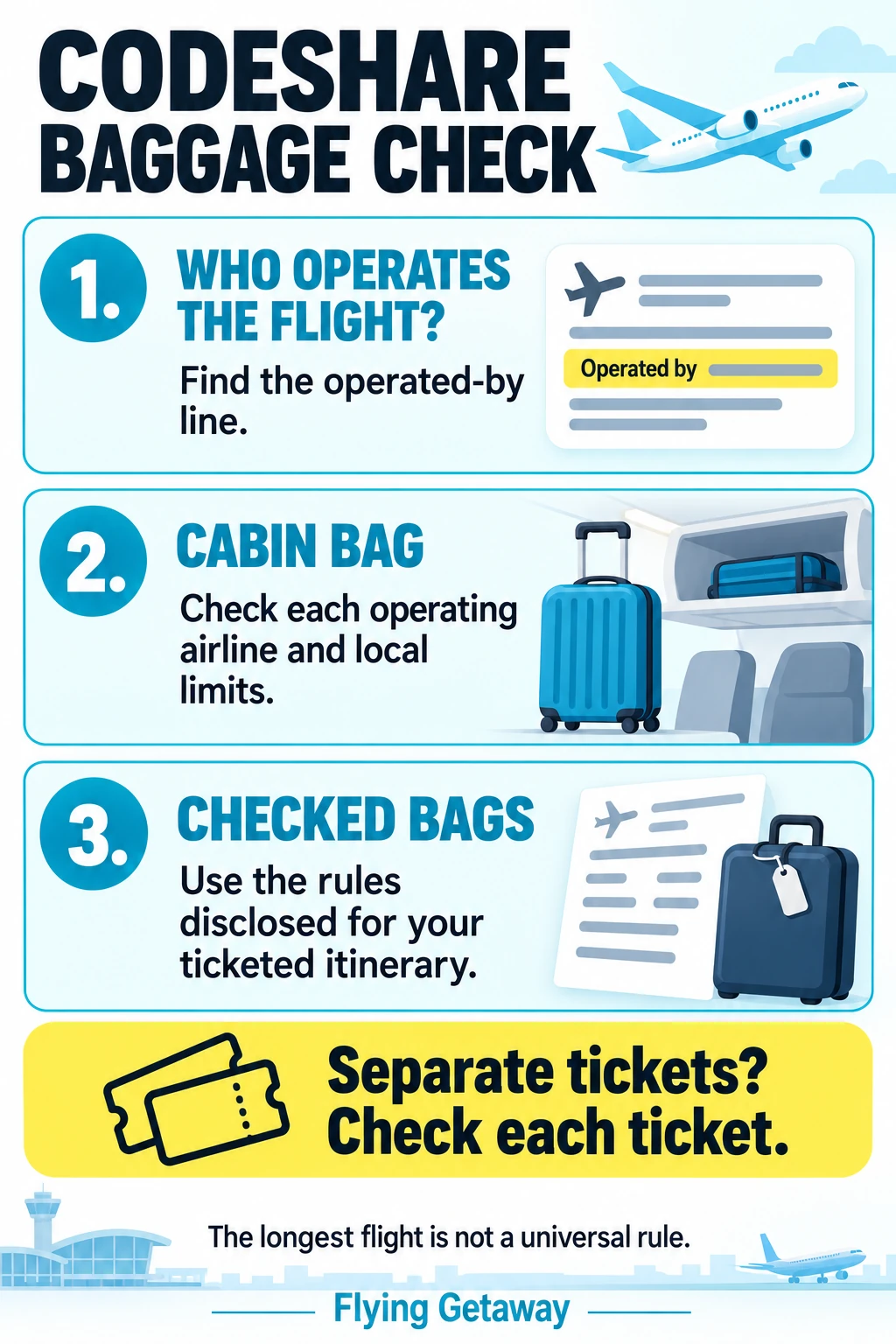
Start with the operating airline on each flight. Lufthansa’s cabin-baggage guidance explicitly says to check the respective operators on a multi-airline journey, including a flight sold with an LH number but operated by another carrier. Local requirements can impose additional limits.
Compare item count, dimensions and weight separately. A bag may fit one carrier’s size limit but exceed the next carrier’s depth or combined weight allowance. Plan for the most restrictive cabin requirement relevant to your flights, and check any route-specific or regulatory exceptions with the carriers.
A checked-baggage entitlement does not automatically solve a cabin-bag problem. If a fare does not include the cabin item you want, confirm the option before arriving at the gate. Likewise, an airline may need to put a compliant cabin bag in the hold because space is limited.
Which airline’s checked-baggage rules apply?
Use the allowance and fees disclosed for the ticketed itinerary. Carrier-selection rules can depend on the journey’s origin and destination, the flight codes, and how the ticket is issued. Do not substitute a general chart from one airline for the baggage information attached to your purchase.
Lufthansa’s multi-airline baggage explanation describes a most-significant-route approach for relevant journeys and separate provisions involving the US or Canada. British Airways’ baggage page also gives guidance for its partner itineraries. These descriptions show why “the operating airline always decides” and “the longest flight always decides” are both too broad.
What changes if my ticket starts or ends in the United States?
US rules require consistent baggage allowances and fees across covered ticketed itineraries. In DOT’s baggage-rule FAQ, the first segment’s carrier determines the applicable rules; if that first segment is a codeshare, its marketing carrier makes that determination. The FAQ also permits an applicable most-significant-carrier approach. Confirm the resulting disclosure rather than choosing whichever allowance looks largest.
That does not cancel aircraft, security or local cabin limits. Ask two questions: what checked allowance and fees apply to this ticket, and what can I physically take into the cabin on each operating flight? Treat a journey merely connecting through the US carefully rather than assuming every routing has identical legal scope.
What are the rules for a single ticket to or from Canada?
The Canadian Transportation Agency’s interline baggage guidance says one set of baggage rules should apply throughout a multi-carrier itinerary to or from Canada purchased on a single ticket, and should be disclosed on the receipt or e-ticket. Check that disclosure before paying for bags separately on each segment.
If the receipt is unclear, ask the issuer to identify the applicable carrier and explain the allowance for the full journey. Do not assume that a single set of rules means unlimited bags, that every item is free, or that you never have to collect a bag at a connecting airport.
Does one booking reference mean I have one through ticket?
Do not rely on the reference alone. Ask whether the journey is issued as a through itinerary or separate tickets, which flights each ticket covers, and whether checked luggage can be tagged to the destination. A single purchase screen or confirmation email is not enough to answer all three questions.
Our booking reference vs ticket number guide explains the difference between reservation and ticket details. Our self-transfer guide explains the additional responsibilities that can arise with separately booked connections. Codesharing itself does not automatically make a journey a self-transfer.
Will my checked bag transfer automatically?
Confirm that separately from the allowance. Lufthansa’s through-check guidance identifies customs requirements, airport changes and local or operational restrictions as reasons baggage may not be checked through in the usual way. A bag tagged to a final destination may still need to be collected and rechecked during a required customs process.
At check-in, inspect the destination printed on the baggage tag and ask where collection is required. Keep the claim receipt. If the journey changes, recheck the baggage arrangement instead of assuming that the original transfer instructions still apply.
What should I ask before booking a codeshare itinerary?
- Who operates each flight, including the return and connecting segments?
- Is the journey one through ticket or separate tickets?
- Which carrier’s checked-baggage allowance and fees are disclosed?
- What cabin-bag limits apply on each aircraft?
- Where must I collect luggage for customs or a change of airport?
- Will a paid bag option cover all intended flights, or only one part of the journey?
Considering a new multi-airline itinerary? Give Flying Getaway the proposed flights and the bags you plan to take: +1 (646) 814-6001. Ask for the baggage inclusions and ticketing arrangement with the quote, so you can compare total costs before buying.
A practical example of the checks
Fictional itinerary: a flight is sold under Airline A’s code but marked “operated by Airline B,” followed by a connection on Airline C. First check B and C’s cabin limits. Next inspect the ticket’s checked-baggage disclosure and ask which carrier’s rules have been selected. Finally confirm the bag’s transfer and any collection point. The letters are placeholders, not actual flight numbers or a promised allowance.
This method avoids two common errors: applying A’s standalone cabin chart to every aircraft, or treating the longest leg as an automatic entitlement to whichever bag count that airline advertises. If information conflicts, ask the seller and carriers to resolve it before purchase or departure.
Need help comparing a connecting journey?
For a new booking, contact Flying Getaway with your route, dates and luggage needs: +1 (646) 814-6001. For an existing reservation made elsewhere, start with the issuer and operating carriers; access to the ticket and the ability to add baggage may depend on who issued it.
Frequently asked questions
Are codeshare flights and interline flights the same thing?
No. Codesharing concerns selling a flight under another airline’s code. An interline itinerary can involve multiple airlines on one ticket without every segment being a codeshare. The ticket and baggage disclosures remain important in either case.
Can I choose the most generous airline’s baggage allowance?
No. Apply the rules selected and disclosed for the actual ticket, together with the cabin restrictions for the operating flights. An unrelated allowance chart does not change your entitlement.
Does a checked-bag allowance guarantee transfer at every connection?
No. Entitlement and handling are separate. Confirm through-checking, customs collection and airport-change arrangements for the specific itinerary.
Sources and policy check
Canadian Transportation Agency: interline baggage rules
Lufthansa: operating-carrier cabin rules
Lufthansa: multi-airline and through-check provisions
British Airways: partner baggage guidance
Official sources checked on 8 October 2026. Verify the rules for your exact fare and itinerary before purchasing.

Patrick Walker is the travel brain behind Flying Getaway. With a knack for spotting flight deals and a passion for exploring new skies, he helps travelers fly smarter and save more with every trip.